Electric current spins a single molecule like an Archimedes screw
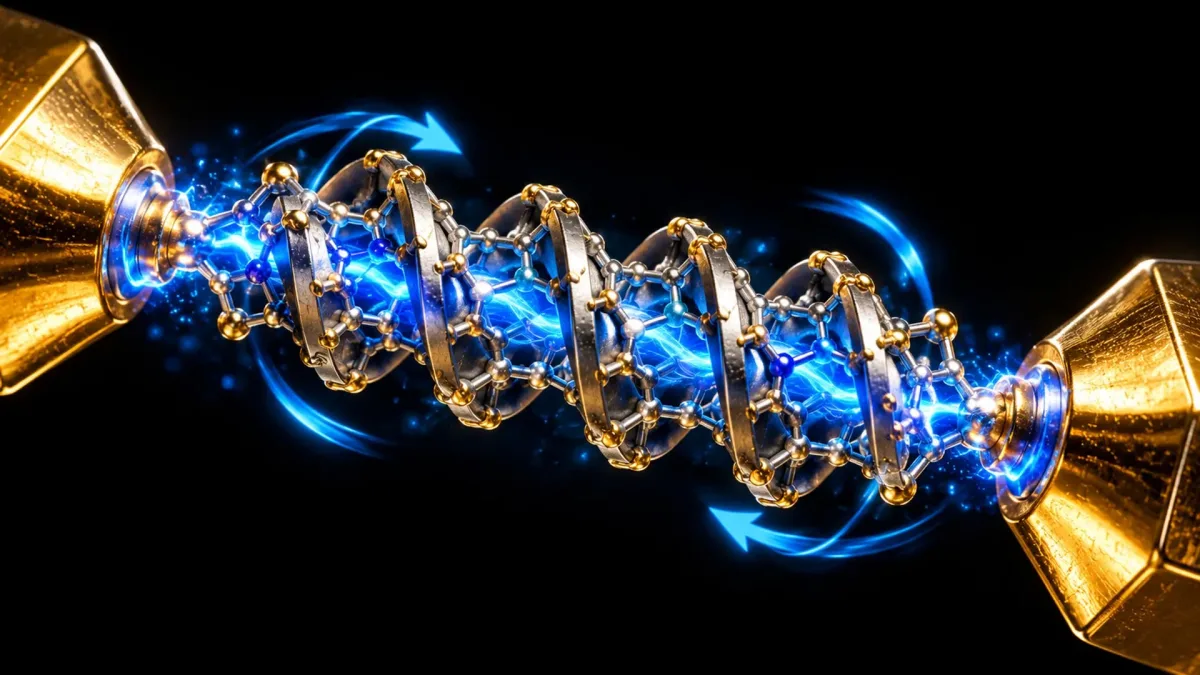
Scientists have built a molecular motor that rotates when an electric current passes through it and can reverse direction when the voltage’s polarity is switched. The researchers describe it as the first demonstration of a molecular motor driven by electrical current, firmly connected to two metal electrodes, and able to rotate in a controllable direction.
Molecular machines are widely seen as a promising next frontier in miniaturization, and nature already runs examples inside living cells. Scientists first built molecular motors powered directly by electricity in 2011, but those designs operated on surfaces and relied on the tip of a scanning tunneling microscope to drive their movement.
An old screw, shrunk
The new motor borrows its design from the Archimedes screw, traditionally used to move water uphill with a rotating spiral. Instead of water, electrons travel through a spiral-shaped molecule, causing it to rotate as current flows.
The spiral molecule was created by the research group of Prof. Michael Pittelkow at the University of Copenhagen. Measuring only a few millionths of a millimeter, it attaches to gold surfaces through sulfur atoms. At the Weizmann Institute of Science in Israel, researchers led by Prof. Oren Tal and Dr. Anil Kumar Singh placed individual molecules between two gold tips sharpened to atomic dimensions. By changing the separation between the electrodes, the team could stretch or compress the molecular screw.
How the molecule turns
Electrons moving through the spiral transfer angular momentum to the molecule, producing rotation much as moving air turns a wind turbine. The spiral’s shape determines how it responds, similar to the difference between screws with right- or left-handed threads. Once the applied voltage passes a threshold, the movement becomes continuous rotation.
The experiments also showed that the rotating molecule conducted electricity far more efficiently than a stationary one. To investigate, Prof. Dr. Fabian Pauly and his PhD students Léon Martin and Yuta Ito at the University of Augsburg ran quantum mechanical simulations on the LiCCA supercomputer. Their calculations showed conductivity changing with the molecule’s angle, increasing by as much as two orders of magnitude, or 100 times, during rotation.
“The surprising thing is that it is precisely the positions that the molecule avoids when at rest that conduct electricity best. It is only the rotation that makes these positions accessible,” explains Léon Martin.
Model matches experiment
The researchers then worked with theoretical physicists Per Hedegård of the Niels Bohr Institute in Copenhagen and Jing-Tao Lü of Huazhong University of Science and Technology in Wuhan. Using the simulation results, they developed a simplified theoretical model that recreated both the observed rotation and the accompanying rise in current.
“In the experiment, you only see the current. Our calculations allow us to glimpse what is happening inside the nanocontact. It was only through close collaboration between experiment and theory across several countries that the mystery of the current increase could be solved,” says Yuta Ito, a PhD student originally from Japan.
The achievement could eventually contribute to molecular electronic components, spintronics, which uses properties of electrons beyond their electrical charge, and microfluidic systems that manipulate extremely small quantities of fluids. It also gives scientists a new way to study physical processes at the atomic scale.
“We have shown that an electric current can be used to generate a directed rotation and that this rotation, in turn, controls the current. This is a new operating principle for machines at the very limits of miniaturization,” explains Pauly.
The work at the University of Augsburg received funding from the German Research Foundation (DFG) through Collaborative Research Center (SFB) 1585 (project number 492723217). The computational research used the University of Augsburg’s LiCCA supercomputer (DFG project number 499211671). Additional support came from the European Research Council (ERC, Horizon 2020, Grant 864008), the Israel Science Foundation (2129/23), the Minerva Foundation, the Villum Foundation, the Novo Nordisk Foundation, the Independent Research Fund Denmark (DFF), the National Key Research and Development Program of China, and the National Natural Science Foundation of China.