Tate St Ives retrospective celebrates ‘lone wolf’ Wilhelmina Barns-Graham
Tate St Ives has opened the first retrospective to span the full career of British modernist Wilhelmina Barns-Graham, an artist the gallery’s director calls a “long-overdue celebration.” At its centre hangs her 1950 painting Glacier (Blue Cave), a monumental altar-piece of turquoise and white that curator Katy Norris describes as full of “mangled” and “twisted” forms.
“Barns-Graham was so distinct in her approach,” Norris said. “There are always questions of: what am I seeing? What is in front of me really? And how does that relate to what I feel inside?” The painting was made only 10 years after the Scottish-born artist moved 500 miles south to the fishing town of St Ives, where she became a key player in the St Ives school during the second world war. She continued to experiment with colour, geometry, kineticism and repetition until her death in 2004, aged 91.
Anne Barlow, director of Tate St Ives, called the retrospective a “long-overdue celebration” of an expressive master. The art historian Virginia Button wrote that “Barns-Graham clearly felt that as a woman she had been unfairly sidelined from the history of St Ives,” which focused on Ben Nicholson, Peter Lanyon and Patrick Heron. She had a brief period of fame in the 1950s, but it waned in the 1960s as her work became increasingly “hard-edged,” as Rob Airey, director of the Wilhelmina Barns-Graham Trust, puts it, and more daring; less commercial and harder to categorise.
Born into an upper-class family in St Andrews in 1912, Barns-Graham faced early resistance when her father became hostile towards her plan to pursue artmaking as a profession. At 18 she started studying at Edinburgh College of Art. “She had a single-mindedness,” Norris said. “She didn’t see any limitations, she just saw the path ahead.”
Film-maker Mark Cousins first encountered her paintings in late-80s Edinburgh. Whether depicting the shorelines of St Ives and St Andrews or the glaciers of Switzerland, he said, “she just leapt off the walls.” He made a pilgrimage to her St Andrews house during lockdown and in 2024 released A Sudden Glimpse to Deeper Things, a film about the artist’s distinctive gaze and synesthesia. Barns-Graham associated colours with people, places, emotions and letters of the alphabet – something she called a “total experience.” “If we think of Turner’s relationship to landscape, he saw a vortex. And Leonardo da Vinci saw a machine. She was like that as well; she saw a living thing,” Cousins said.
Her encounter with the Grindelwald glacier in Switzerland came in 1949. “That day was almost like a rebirth, a kind of rapture,” Cousins said of the hike and the 60-odd paintings and drawings that followed over three years. In a letter to the Tate in 1965, she wrote: “It seemed to breathe!”
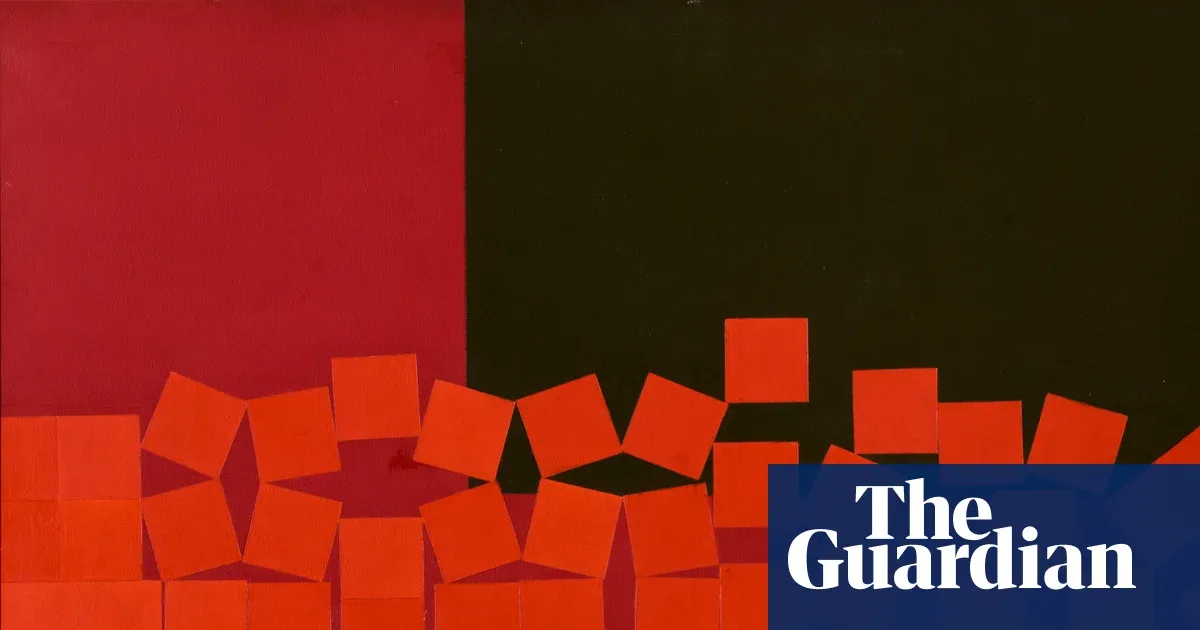
In the 1960s and 1970s, in a body of work titled Things of a Kind in Order and Disorder, Barns-Graham laid out small cardboard squares in neat rows on her studio floor before randomly nudging them with her foot. Norris said this was where she truly pioneered a new way of experiencing the world – “like chaos theory, really.”
Her marriage ended in divorce in 1963. Referring to her 1968 painting Olive Green Squares on Vermillion, she compared the erratic block of squares against a rage of red to “a broken marriage” – her own. Yet with Protest, made in 1967 as the Vietnam war raged, “she was [also] thinking about participation and action and what you can do as an artist or viewer,” Norris said. “She’s making the moves, she’s a part of it, she’s no longer in awe of a natural phenomenon that’s doing its own thing.”
When the Beatles came along, “working-class men were cool and posh women weren’t,” Cousins said. “But she just kept going.” In the 1980s, her tumult of squares gave way to the pen-and-ink lines of her Small Energy Drawings. “Are they soundwaves? Is it the wind?” Norris asked. “Sometimes she’d look out from the cathedral-esque window of her studio in St Ives and turn her back to it, playing music and drawing lines that replicated the sea.”
“At my age there’s no time to be lost,” Barns-Graham said in the 1990s. “I say to myself: ‘Do it now, say it now, don’t be afraid.'” Incensed by what she called “the most appalling time of abuse of living things,” she painted with urgent, physical energy in her eighties. “The St Ives narrative flattened her,” Cousins said. “It saw her as one of many. It is important to extract her from St Ives and see her as a singular imaginative person.”