Franco-German car deal would secure only 13% of Europe’s planned battery cells, T&E says
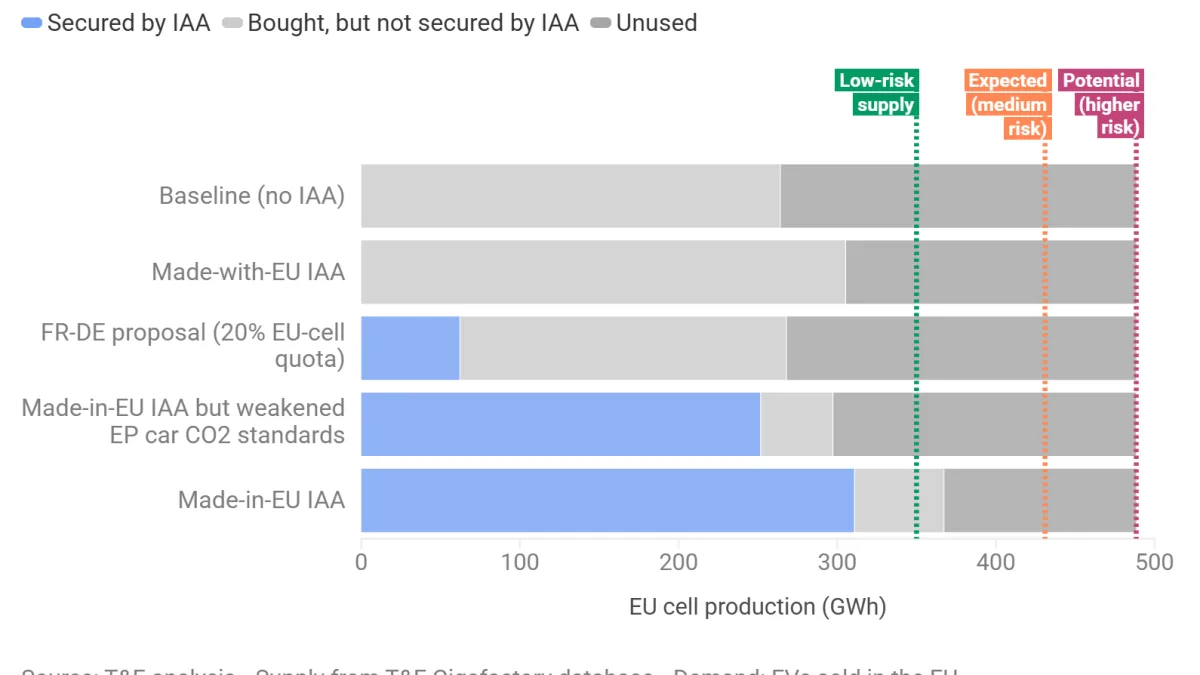
The Franco-German car deal will secure just 13% of Europe’s planned battery cell production in 2030, according to a new analysis by the transport and environment group T&E. The group says weak Made-in-Europe rules, combined with weaker emission reduction targets, risk handing the battery production market to Europe’s competitors.
The analysis finds that 100 GWh of cells and 250 GWh of cathodes could leak abroad because of weak Made-in-Europe rules — equivalent to 1.5 million battery packs. T&E says the Industrial Accelerator Act (IAA) introduces local content requirements to ensure scarce public subsidies and corporate tax incentives anchor homegrown EU manufacturing.
At the same time, T&E says Europe’s battery industry faces a double blow from the EU Parliament’s proposals to weaken emission reduction rules, which it says will cut cell demand by 247 GWh, or approximately 3.7 million EU-made EVs between 2027 and 2032. That is almost three times the annual capacity of Europe’s largest battery plant, LG Energy Solution in Poland.
Franziska Grüning, Raw Materials Officer at T&E, said: “The Franco-German deal is a disaster for Europe’s battery industry. Securing a full European battery value chain, from mining to production, and the high value jobs it will provide, should be a top priority for Europe’s leaders. Instead, they are debating how far to weaken rules that would secure domestically produced batteries. Weak local content incentives for batteries in the IAA will send a terrible political signal for the future of Europe’s battery industry. Homegrown companies struggling to cross the valley of death should benefit from an IAA demand boost.”
With many cell factories only just beginning to ramp up, most EU production expected by 2030 comes from plants that have not yet entered production. T&E says the future of factories such as Lyten (formerly Northvolt) in Sweden, PowerCo Salzgitter in Germany, or Verkor Dunkirk in France could be jeopardised by the deal.
Key findings from the analysis:
- The Franco-German deal locks in less than the market already does: it requires EU-made cells in only 10% of eligible vehicles in 2028-2029, 20% in 2030-2031 and 70% from 2032. Yet over 50% of cells in EVs sold in the EU are already made in Europe.
- In 2030, the Franco-German deal would secure cell production equivalent to around 0.9 million EVs, against 4.6 million under a Made-in-EU IAA.
- Including free trade (FTA) partners shifts demand abroad: a wide FTA scope lets low-cost countries absorb demand before Europe. Around 100 GWh of cell demand, or approximately 1.5 million electric cars, and 250 GWh of Cathode Active Material (CAM) demand are at risk of leakage in 2030.
- The IAA can build the EU’s midstream: cells are important but so are their components. CAM producers need large, stable contracts with cell makers and carmakers before they can ramp up. Under a strict Made-in-EU scope, CAM requirements are reachable by 2030, with only limited supply from trusted partners. From 2032, EU production alone could cover demand: the IAA would create 323 GWh of additional demand, bringing total EU-made CAM to 407 GWh and securing 94% of expected EU supply.
T&E says the EU’s battery industry must not go the same way as its solar panels industry. It calls on the EU to reject the Franco-German deal proposal on batteries and stick to the timelines and battery requirements of the EU Commission’s proposal. It also calls for a strict Made-in-EU scope, or at most a narrow list of trusted partners of the EU27 plus the European Economic Area (EEA) and the UK, and says there should be no further weakening of the car CO2 standards.