Three Leaders, One Table, and No Words Afterward
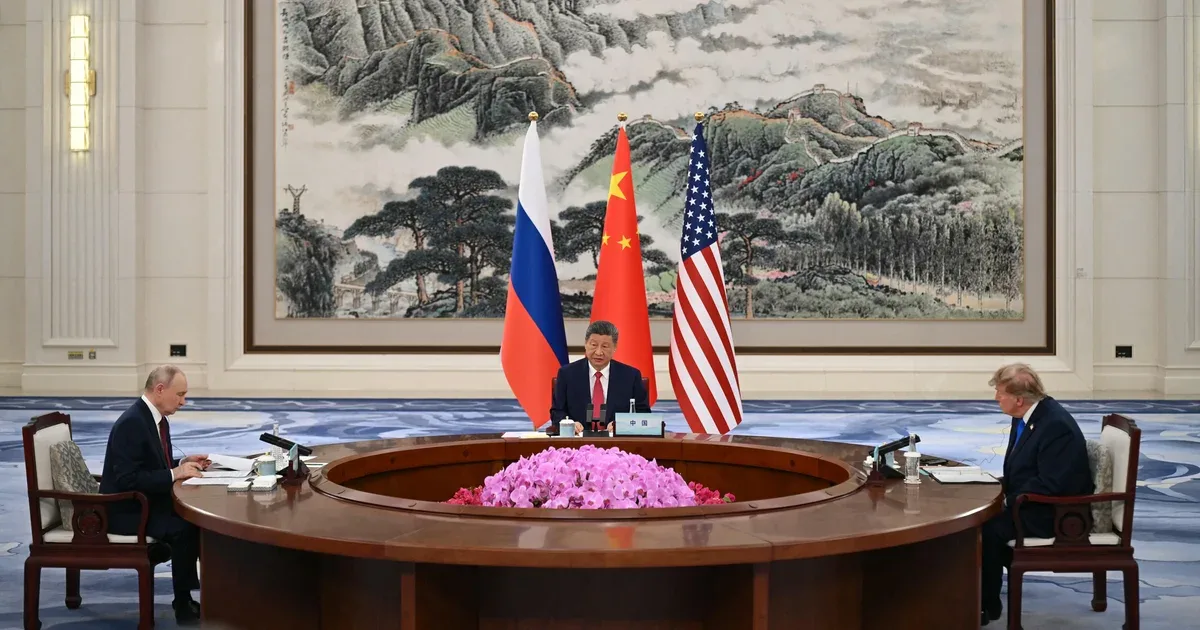
President Trump, Xi Jinping and Vladimir Putin sat down together in Shenzhen on Thursday, meeting behind closed doors for about an hour and a half on the sidelines of the APEC summit. None of the three offered a joint or separate statement to reporters afterward, and Trump left immediately for the airport.
The meeting was built out of bilateral sessions rather than a single set piece. CBS News reported that Trump met Putin first, with cameras capturing the president entering a small conference room alongside Secretary of State Marco Rubio and Treasury Secretary Scott Bessent to face Putin, Foreign Minister Sergey Lavrov and other Russian officials. As Trump approached for the handshake he joked, “Who is that?” before laughing and calling Putin “my friend.” CBS reported that Russia’s TASS news agency said the war in Ukraine was the main topic of that session and that Putin left in “an excellent mood.”
Trump then met Xi for about an hour before the three-way gathering. According to CBS, Xi told Trump that relations between China and the United States were “stable and improved,” and Trump told reporters he had spoken with Xi for two hours the previous day, with trade and tariffs the main topics.
What each outlet chose to foreground
The two accounts of the summit diverge in emphasis in a way that is itself informative. CBS News framed the day around the choreography and the silence: the sequence of bilaterals, the closed door, the absence of any statement afterward. Its one substantive read on the Putin meeting is attributed to a Russian state agency, not to an American official.
NBC News led instead with what Trump said before the meeting, reporting that he spoke about reducing the number of nuclear weapons, saying “it’s very hard to give them up” but that the three nations were positioned to lessen risk. That is a policy signal CBS’s account does not carry, and it sits oddly beside the fact that no leader said anything on the record once the doors closed.
The gap matters. One outlet gives us a stated ambition on nuclear reduction; the other gives us a meeting that produced no public words at all. Neither reports an agreement, and CBS is explicit that there were no joint or separate statements.
The pattern here
Read together, the two reports describe a summit whose only confirmed content is atmospherics — a handshake, a friendly joke, a Russian agency’s readout of Putin’s mood, and Xi’s characterisation of the bilateral relationship. The nuclear comment is the sole item that could be called substantive, and it was offered to cameras beforehand rather than negotiated at the table.
There is also a telling detail in CBS’s account of Trump’s remarks to reporters: he said he would be asking China to “do some more” — the sentence trails off in the reporting as supplied, with the object of that request unstated.
Why it matters: a three-way meeting of this kind is significant precisely because of who is in the room, and the reporting establishes that much clearly. But the coverage also shows how little can be verified about what happened inside it. When the only readout of a Putin meeting comes from TASS and the only policy morsel comes from a pre-meeting comment, the public record of a historic sit-down rests on atmospherics and attribution. That is the story the outlets are actually telling — not what the three leaders agreed, but how little any of them chose to say.