LiTime’s Lares K1 puts 24 hours of fridge backup in your kitchen
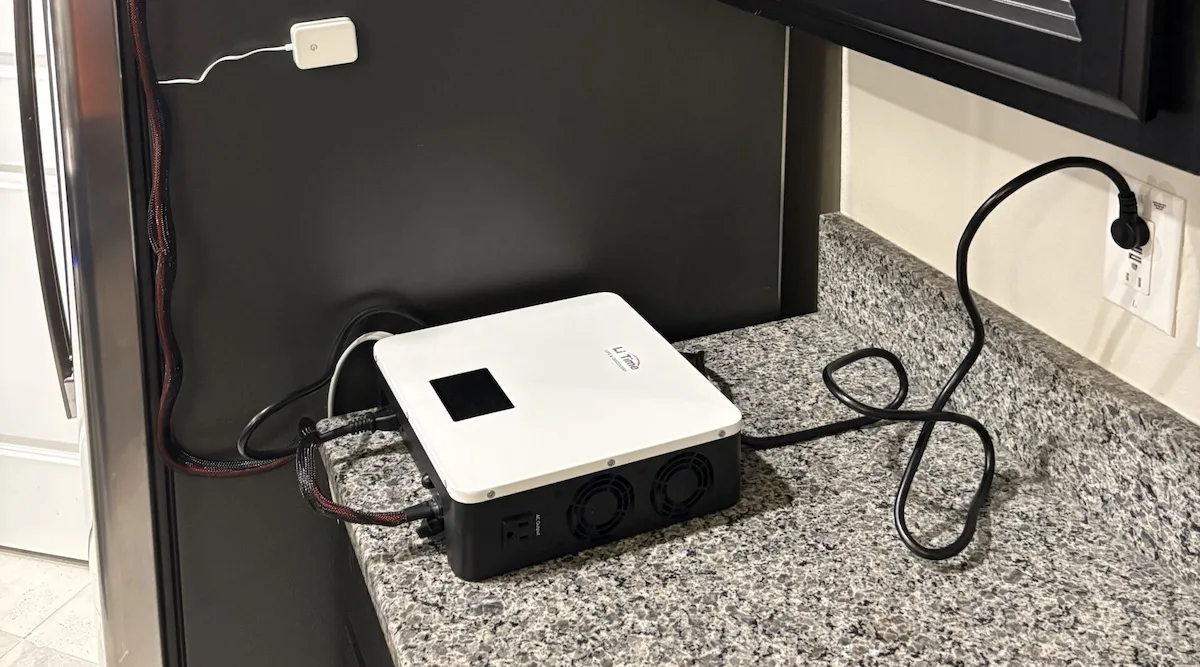
LiTime launched the Lares K1 in the US on October 20, 2026, and the company calls it “space-based” home backup: instead of powering a whole house, it protects one room. The system plugs into a wall outlet, and the refrigerator plugs into it. No electrician and no panel work are needed.
The K1 is a split system — a slim inverter charger paired with a separate 2,304 watt-hour LiFePO4 battery (51.2 volts, 45 amp-hours). Up to four batteries can be added, bringing the total to 9,216 watt-hours. The battery is rated for 4,000 cycles and carries a 5-year warranty.
The inverter delivers 2,000 watts continuously and 4,000 watts of surge for one second, as a pure sine wave at 120 volts. Adding batteries does not raise that output; it only adds runtime. There are two AC outlets, one on each side of the inverter, and no USB ports were listed. Charging runs at up to 1,500 watts from a wall outlet and up to 800 watts from solar (12 to 60 volts), with combined input capped at 1,500 watts.
LiTime does not put a charge time on the main product page. Dividing 2,304 watt-hours by the 1,500-watt wall input gives about 90 minutes from empty to full — a rough estimate, since charging usually slows near 100%. The company’s FAQ later puts the theoretical time at about 1.7 hours at 90% charging efficiency.
The inverter charger weighs about 10.1 pounds. LiTime does not list the battery weight; the reviewer weighed it out of the packaging at about 52 pounds. With the floor stand, the two modules together measure 20.47 inches wide, 30.71 inches tall and 3.94 inches deep. It runs at about 40 decibels, switches to battery in 10 milliseconds or less, and includes a touchscreen, Wi-Fi, Bluetooth 5.0, the LiTime app and a time-of-use mode for off-peak charging.
The price on LiTime’s site is $1,099.99, shown as $100 off. Preorders opened October 20, 2026, and at the time of checking, estimated delivery was November 24 to 27.
Runtime and load limits
LiTime estimates about 24 hours of backup on a large side-by-side refrigerator using about 2 kilowatt-hours a day, or about 99 hours with four batteries if the fridge is the only load. The reviewer got a bit more than that in testing. Depending on the load, the system can also run a microwave, an air fryer, a toaster or a coffee maker for a basic meal — but not all at once. Two smaller loads can run together; a large load such as a microwave or air fryer needs to run by itself, though the refrigerator can stay plugged in. LiTime says to allow for compressor startup if one of those is also running.
The system can be wall-mounted, stood on the floor or leaned against a wall, with the two modules together or apart. It ships with mounting hardware and two connection cables, 0.25 meters and 1.5 meters (about 10 inches and 5 feet). The battery housing is steel, and LiTime says the metal finish is meant to suit a kitchen. The inverter is rated IP20, so it stays indoors. LiTime says separating the inverter from the battery cuts down on heat transfer, which it claims helps the battery last longer; the reviewer has not measured that.
The reviewer describes the plug-and-play format as a new product category. Portable generators have been available for years for camping or appliance backup, but a product tailored to a specific room is a new concept. LiTime compares the one-room approach with a whole-house battery system, which usually needs panel work and costs about 10 times as much. The K1 can be used for camping or travel, but it isn’t built for it: split modules, wall-mount hardware, only two AC outlets and no USB ports point to a permanent kitchen install.
Testing
The reviewer used an old Kill-A-Watt meter to independently measure the refrigerator’s draw on the battery, opening the fridge less than normal during the test but still about 10 times. In the appliance test, one device ran at a time first, then several together. The unit is rated at 2,000 watts continuous with a 4,000-watt surge for one second. In one run it pulled 2,510 watts from the battery while the load was only 2,290 watts; the reviewer attributes the other 220 watts to the inverter converting DC to AC.
Extending backup time
One to three expansion batteries can be added for about $800 each, for roughly an additional 24 hours each. A couple of 400W solar panels and long MC4 cables for about $600 would provide about 2 to 3 kWh a day when sunny, saving about $100 a year at 10 cents a kWh and more at higher electricity rates. Because the system does not push power back into house wiring or the utility grid, the reviewer notes, buyers do not have to live in a state that has legalized plug-in solar. The unit could be uninstalled and driven somewhere with power to charge to 100% again, while a small battery generator keeps the refrigerator running in the meantime. Filling empty space in the refrigerator and freezer with plastic water bottles — leaving air in them, since they expand 9% — is offered as a further step.