Missouri startup’s driverless railcars chase diesel off short lines
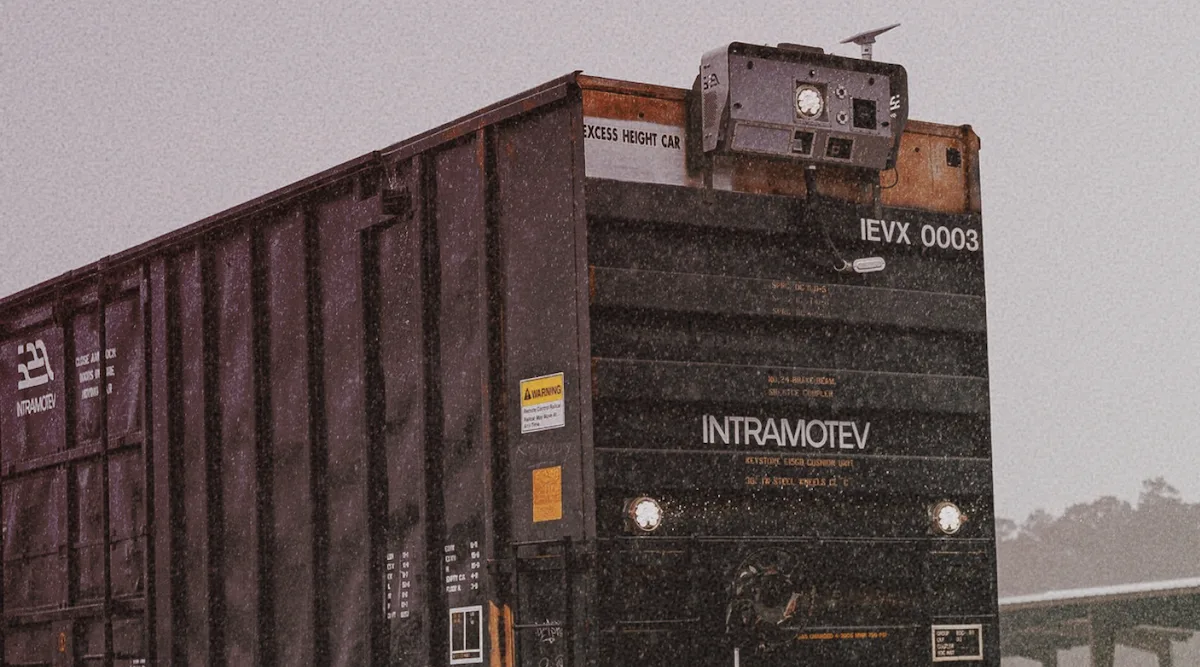
A Missouri-based startup is retrofitting freight cars to move under their own electric power, aiming to cut diesel use on the nation’s short line railways. Intramotev’s “TugVolt” system lets railcars haul freight without a locomotive, CleanTechnica reports.
The company surfaced on CleanTechnica’s radar in 2023 with two retrofit products. The ReVolt is a battery pack that slots onto existing railcars hauled behind a locomotive to save diesel fuel. The TugVolt is an autonomous, electrified system that lets railcars haul freight on their own without a locomotive.
Each TugVolt’s battery packs have limited range, but enough for a day’s work including “first mile” loading duties. Once loaded, the cars can hitch a ride on locomotives for long-distance travel, then split off to unload. A freight yard with a full complement of autonomous railcar EVs would need little, if any, help from diesel-powered switcher locomotives. Each TugVolt can also work as a switcher, moving conventional railcars into position behind a locomotive.
The technology could also cut emissions from highway freight: the closer an electric railcar gets to its destination, the less a diesel truck is needed to cover the last leg. Intramotev is focusing on captive or short line routes, many of which have lost traffic to trucking competition.
Army exercise and a Texas yard
In June, Intramotev lent a TugVolt to a US Army Reserve training exercise at the Camp Shelby Joint Forces Training Center in Mississippi, billed as the largest training exercise in the history of the Army Reserve. According to Defence Blog, soldiers trained on and operated the TugVolt system under company supervision throughout the exercise and quickly became proficient. The outlet noted that military rail operations have traditionally required specialized rail crews, a category the Army has struggled to keep at sufficient strength given how rarely large-scale rail movements occur outside major deployment exercises.
Defence Blog reported that the exercise went off script when railcars loaded with military supplies arrived at the site. With their fresh training, participants deployed the TugVolt to organize the incoming railcars for unloading.
On November 3, Intramotev expanded its relationship with Watco, a holding company specializing in short line railways. The arrangement calls for TugVolt to pull zero-emission switcher duty at a to-be-named industrial facility in Seadrift, Texas. Railway Age noted that the Texas assignment adds to Intramotev’s US footprint, which also includes Michigan, the Army demonstration in Missouri and a forthcoming agreement in Kentucky.
Railway Age further reported that in April, Intramotev took part in electrification efforts in Austria. The client is ÖBB, Austria’s national railway, making it the first deployment of TugVolt technology under regulation and Intramotev’s first overseas client. ÖBB runs more than 1,000 freight trains across 18 countries every day.
A $16.3 million federal grant
The Federal Railroad Administration branch of the US Department of Transportation has awarded a $16.3 million grant, with US taxpayers shouldering the bulk of the cost-sharing arrangement, designed to model best practices for introducing EVs into the nation’s railway system. The project is hosted by the Columbia Terminal Railroad, a city-owned, 21.4 mile line linking Columbia and Centralia in Missouri.
“The project will deploy autonomous railcars on the line to produce the first documented safety record for autonomous railcar operation and create a workforce training curriculum,” the FRA said. The agency said the project was selected for Project Development, Final Design, and Construction and involves research and workforce development for a phased autonomous rail technology and short-line infrastructure modernization program. The FRA said the project “aligns with the selection criteria by improving system and service performance,” with the goal of enabling freight to run more frequently and, ultimately, autonomously.
The grant of up to about $16 million is part of a $2.3 billion railway CRISI modernization package, with CRISI short for Infrastructure and Safety Improvements. The program provides federal funding to “mitigate congestion at both intercity passenger rail and freight rail chokepoints to support more efficient travel and goods movement.”
Citing Intramotev official Don Soffer, the News Tribune noted that “more than 600 short lines in the U.S. have declined in use in recent decades due to their relative inefficiency.” The outlet continued that cross-country hauling is more profitable for companies, whereas short lines require very large hauls to justify the quick trip, and that the Columbia Terminal Railroad does not operate on a set schedule, hauling whenever enough goods are collected.
Practically the entire US locomotive fleet runs on a diesel-electric platform, meaning electric motors powered by an on-board generator. While fossil energy is still in play, the diesel-electric configuration is more energy efficient than sending fleets of diesel trucks onto the highways. The trucking industry has also been wrestling with an ongoing driver shortage, adding motivation to move more freight onto rails.
The FRA announced its selection for Project Development, Final Design, and Construction in October, so steps remain before the TugVolt begins running. The Army has been slow to adopt EVs, and last year’s sharp U-turn in federal energy policy did not help, but the service has been sending signals through new “anti-idling” kits for ground vehicles and a new contract with the US branch of Rheinmetall for a fleet of crewless hybrid cargo haulers.