Amazon’s food-stamp workforce nearly tripled, GAO finds
Working Americans now take home 52.8% of economic output, the smallest share since the Bureau of Labor Statistics began tracking the measure in 1947. Over roughly the same era, corporate profits have climbed sharply: the S&P 500 is up 600% since the start of the century, while inflation-adjusted wages rose 12.5%.
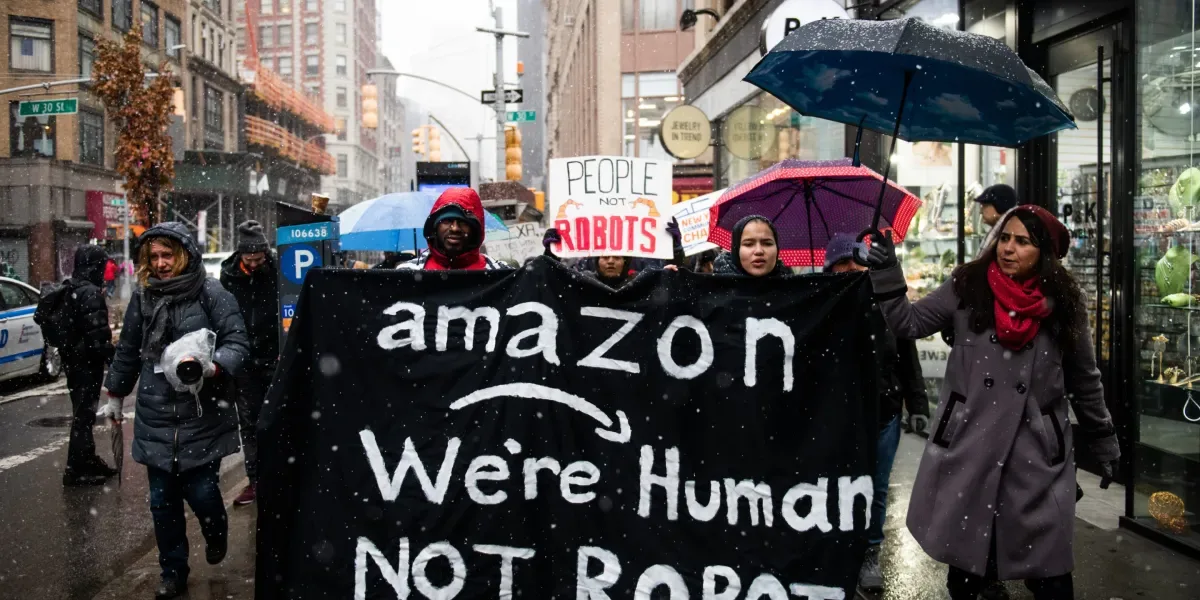
A recent Government Accountability Office report, covering the 11 states it sampled, found that Amazon — the country’s largest company by revenue — has 12,346 workers on the Supplemental Nutrition Assistance Program and 11,338 relying on Medicaid. That was nearly triple the number of Amazon employees needing federal assistance compared with 2020, when the GAO ran a similar report. Over that period, Amazon’s annual profits rose from $11.6 billion to $77.7 billion. Its 2025 revenue climbed 12% year over year, from $638 billion to a record $717 billion.
Amazon spokesperson Rachael Lighty told Fortune the conclusion drawn from the GAO report is “wrong,” and that looking at raw numbers rather than percentages is misleading. “When you look at the actual facts, you see that Amazon pay is among the best in the industry, regular full-time employees have access to health care from their first day—at only $5 per week with $5 copays for employee-only coverage—and 74% of our regular full-time employees are enrolled in an Amazon health insurance plan, well above the 65% private-sector take-up rate for full-time workers,” she said in a statement. “We challenge other large retailers to provide the same Day 1 comprehensive health care benefits that we do.”
Walmart and FedEx saw similar increases in the number of workers taking federal assistance, as did ride-share and delivery companies. Kathryn Larin, director for education, workforce, and income security issues at the GAO, told Fortune the data shows that Americans using social safety net programs today are overwhelmingly in the workforce, with most working full-time. The income threshold for SNAP eligibility is about 130% of the poverty line.
“What this analysis really points to is the large number of people who have very low incomes and continue to have very low income,” Larin said. “I mean, these are families that are really barely able to make ends meet, and yet they are working, and they are working a lot.”
Diane Swonk, chief economist and managing director at KPMG, recently warned of the hidden consequences of a shrinking labor share, particularly that most Americans face an ongoing affordability crisis even as economic indicators suggest stability. KPMG found in February that since 1982, corporate profits as a share of U.S. GDP rose from 8% to 15.85%, while employee compensation as a share of GDP shrank from 66.6% to 61.9%.
“This chart from my recent Economic Compass still haunts me,” Swonk said in a social media post at the time. “A friend refers to it as the ‘revolution chart,’ which [is] disturbing but telling. Inequality fuels social and economic instability.”
How the labor share unraveled
The trend is about 50 years in the making, according to Anna Stansbury, an assistant professor of work and organization studies at the MIT Sloan School of Management. Fewer U.S. workers are represented by unions — 20.1% in 1983 versus 10.0% in 2025 — giving them fewer chances to bargain for pay and benefits. More than that, Stansbury blames the fissuring of the workplace, or the breakdown of the employer-employee relationship.
Direct employment was once the norm: a large bank like Bank of America used to employ a janitor to clean its offices. But “in more and more cases, that’s not actually people’s experience of the workplace, particularly in lower middle-income jobs,” Stansbury told Fortune. Large workplaces now hire gig workers or subcontractors for jobs once done by direct employees — a security provider supplies the guard outside the office, delivery drivers work as contractors. Companies avoid providing those workers equity or benefits, and if a subcontractor violates labor law, the contracting company is not liable, Stansbury explained. The companies also argue they are raising efficiency by not spending on roles that do not directly drive revenue.
Brent Neiman, a professor of economics at the University of Chicago, said he believes AI has been the key driver of diminishing labor shares. In a New York Times op-ed, he argued the technology’s productivity promises pose the greatest threat to wages. “Anyone who has used ChatGPT can see how much work now done by people could soon be done by technology,” he wrote.
Apollo chief economist Torsten Slok has observed a correlation between AI adoption and lower wages. In a July white paper, he and economist Sania Edlich found that among 321 occupations between 2015 and 2025, jobs with high exposure to AI saw a 6.7% decline in real wage growth after 2023, following the wide release of ChatGPT, despite no employment changes.
What comes next for wages
Stansbury has a somewhat different theory on AI. The technology could eventually have an aggregate impact on the labor market, but it is still too early to say whether today’s shrinking labor share is part of a broader cycle or a secular shift, she said. Unexpected inflation spikes, like the current one, are usually associated with poorer real wages. If inflation is less volatile in coming years and wage growth recovers, the trend could prove cyclical.
A tightening labor market should raise labor share, and the market is already relatively tight, Stansbury noted. If inflation stabilizes, employment stays narrow and labor share rises, it would signal a cycle completing itself. The bigger problem would be wage growth staying low even as inflation improves and the labor market stays tight.