World makes 45 solar panels a second, dwarfing TV output
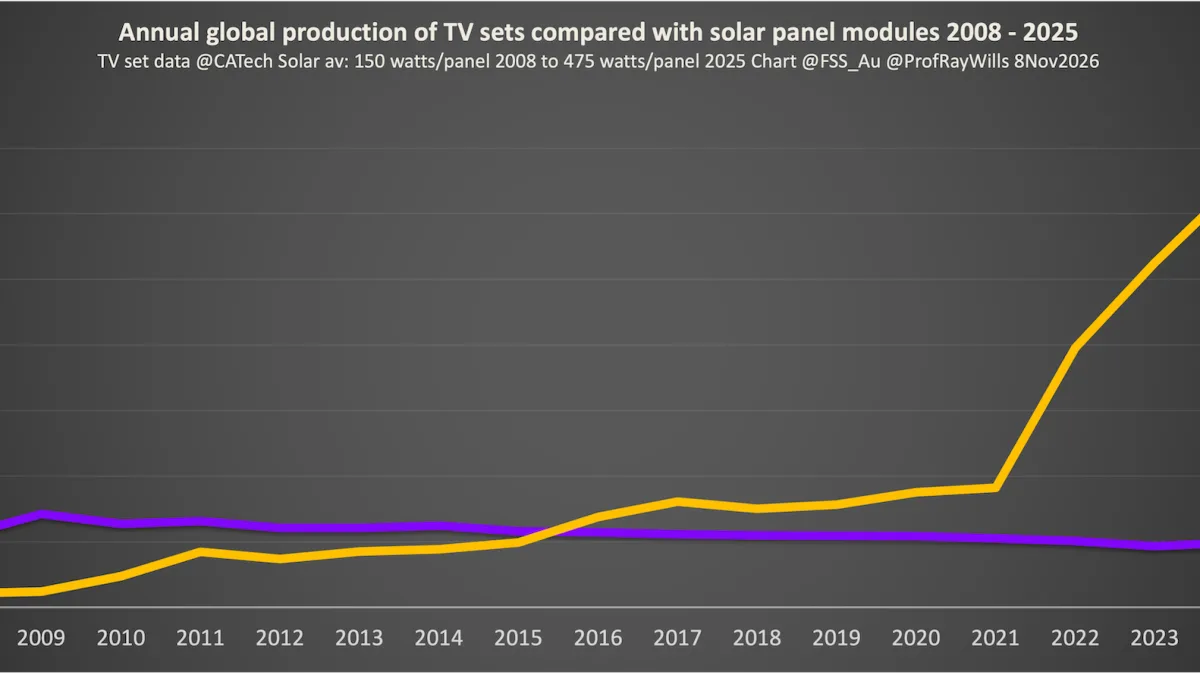
The world is on track to make about ten times as many solar panels in 2026 as it did in 2015, when production stood at six panels a second.
Writing for CleanTechnica, the author recalls posing a simple test at an Australian clean-energy conference in 2015 hosted by Renew Economy Disruption and the Energy Industry: if the world was still making more panels that consumed electricity — TVs — than panels that generated it, the real solar boom had not yet arrived. On the updated chart, solar overtook televisions in 2016. By May 2018, when the author spoke at Power Philippines in Manila, the crossover became a line in journalist Lala Rimando’s live coverage of the talk: “We are now making more solar panels than TV sets.”
Passing televisions was an important milestone, but the author calls it the least interesting part of the story. In 2021, the world made an estimated 360 million solar panels. A year later, it made about 790 million. By 2025, annual production had reached about 1.4 billion panels, against just over 200 million televisions.
The gap opened not because the world stopped making TVs, but because it started making solar panels on a much bigger scale. Put another way, the world went from about six solar panels a second in 2015 to about 45 in 2025, averaged across every second of the year. The author’s full-year estimate for 2026 puts the rate at about 62 panels a second — nearly two billion panels in a year.
And the panel count tells only part of the story. The average module rating used to estimate those counts rose from 150 watts in 2008 to 475 watts in 2025. At that 2025 rating, 1.4 billion panels represent roughly 665 gigawatts of rated generating capacity coming out of factories in a single year.
Televisions offered a familiar yardstick for what mass production for a consumer market looked like. A decade later, the author writes, the question isn’t whether solar can match that scale. It’s how quickly all those panels can be put to work — the fastest shift in energy in human history.