Photographer recalls bare-handed beekeeper who wore a swarm on his face
Holly Lynton’s Bare Handed series began with a bird caught in the netting around the raspberry bushes in her backyard. It made her think about how humans interact with the natural world, and how they can obtain food and other necessities while still being good stewards of the land. She had seen photographers document how Big Agriculture was destroying the environment. She wanted to find people who took a respectful approach and tried to work in tandem with nature, but who might be in a fearful or dangerous situation.
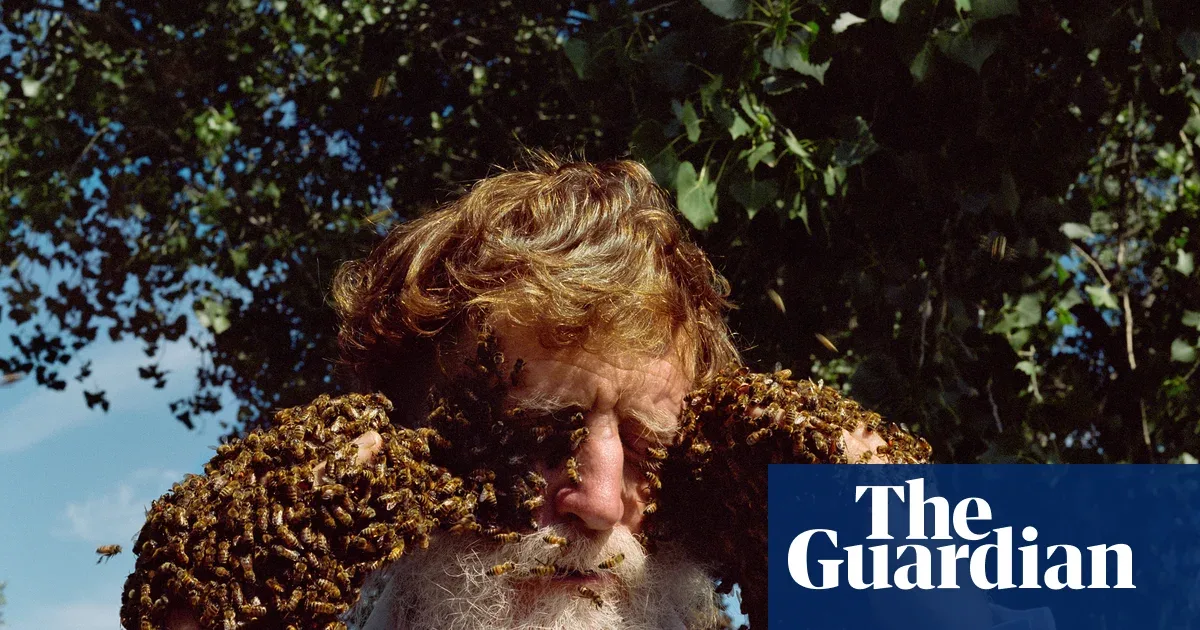
Lynton approached Les, the man in the photograph, after speaking to the director of an exhibition space in Albuquerque, New Mexico, who had hired him to remove a feral beehive from his tree. She had already tried to photograph another beekeeper who wore a full protective suit, but he might as well have been an astronaut. With Les, she was able to stay nearby and work with him over three days. The first couple involved straightforward documentary pictures of him tending his hives. Then, on the third day, his apprentice Amber showed up to help.
Les had the queen bee in a cage in his shirt pocket and asked Amber to take it out. Wherever the queen is, the rest of the colony will swarm. There is a picture Lynton made where Les and Amber are joined together by bees, and that was her “ah ha!” moment. Amber took out the queen and placed her in Les’s hand, which is where the bees went next. He looked at Lynton with his hands full of bees and said: “Should I put them on my face?” She said: “Sure!”
Les slowly moved his hands up to his face. Bees don’t like hair, which is why they’re not in his beard or the top of his head. He closed his eyes for a few minutes, and Lynton photographed. Afterwards, he said: “You know, I couldn’t hear anything but the buzzing.” Lynton does not think he had ever done that before. People sometimes have their own ideas, which she just goes with. One of the reasons she likes spending time with them is that when they are engaged in work, it is almost like watching a dance and waiting for the right gesture.
The bees were landing on my hands while I was looking through the lens. I could feel them but not see them
Les didn’t wear gloves when handling the bees. He said he needed to be able to feel them so he didn’t crush them, and that it was too hot to wear a suit. Lynton wore a shirt that buttoned up tight at the wrists and tried wearing a beekeeper’s veil, too, but she abandoned that after finding it hard to focus through the mesh. She did get a bee buzzing in her ear and had to walk away until she let up.
Lynton was using a medium-format analogue camera, and the bees were also landing on her hands while she was looking through the lens. She could feel them but not see them. That was disconcerting, but Les advised her just to move slowly, as he did. That worked: she didn’t get stung. For a while, the photograph of Amber and Les joined together by bees was the one she preferred. She was worried people would find the bees on his face over the top. The themes of the project were quickly reinforced when she photographed wolves in a sanctuary with their trainers, and then went out with a family of catfish noodlers in rural Oklahoma. “Noodling” involved them catching these fish with their bare hands – even though they can weigh 45kg and really fight back. She realised none of these people had any fear. They were all experts at whatever it was they were doing, and for them this was a spiritual, meditative practice. That became the focus for the series.
Before she started taking photography classes, Lynton planned to be a psychologist and a writer. But what she loves about photography is that you can create ambiguous narratives, a multilayered story in a single frame. A lot of her work references cultural memory. Rather than straight documentary, she is aiming for something more mythic, and gestures that happen spontaneously can sometimes seem to reference a certain myth or biblical allusion. This photograph leans more towards Greek mythology, even if it doesn’t directly reference an exact story. Les isn’t Odysseus but, like him, he elects to hear rather than protect himself, which makes him feel like he’s a part of The Odyssey, somehow.
Holly Lynton’s CV
Born: Boulder, Colorado, 1972
High point: High points occur when my photographs are both made and shown. When photographing, a high point is when everything aligns – the light, content, composition – and I create an unanticipated image that transcends the moment. One that elicits allusion, mystery and wonder. In terms of exhibitions or publications, it’s often what is recent. In the past few years, institutions as varied as the Nelson-Atkins Museum in Kansas City and Bristol Cathedral in England have exhibited my work. I’m thankful that institutions have enabled people from many different backgrounds and perspectives to see my photographs. Talking with viewers and hearing their reactions has been a real gift. My book Bare Handed, published by L’Artiere, was another high point.
Top tip: Right now, the quest for authenticity instead of artifice feels crucial, and what I’d urge photographers to undertake. I’d also say there is no such thing as too much curiosity (even though some people might make you think so). Don’t be afraid to change your mind about what you are working on, the meaning behind it or how to go about it. Reframing is what I like to call it. Follow your intuition. And find the joy in the practice of making work and being creative. Difficult moments will occur, and ones that feel like failures, but it’s the journey, not the end goal.
Holly Lynton’s exhibition, Beyond the Bounds, is at Bristol Cathedral until 15 November, part of Bristol photo festival.