MIT pours a concrete beam in a sewn fabric mold, using a third less concrete
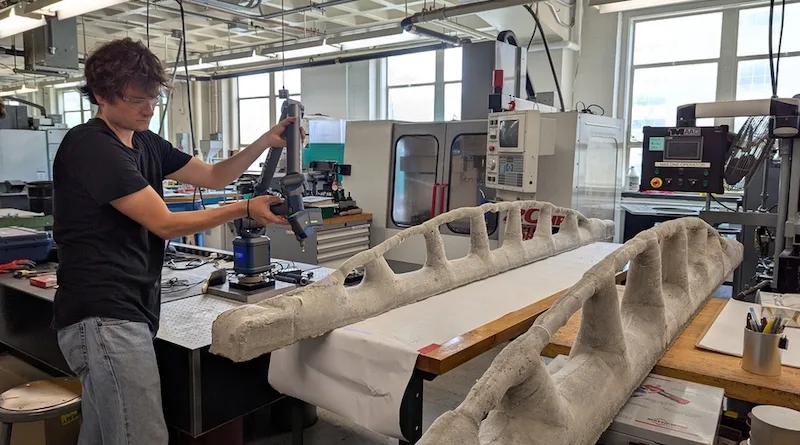
MIT engineers have cast a concrete beam in a mold sewn from fabric, using about one-third as much concrete and half as much steel reinforcement as a conventional beam built to carry the same weight, CleanTechnica reports.
The team designed and built a 3-metre (about 10-foot) test beam using fabric molds made through an automated pattern-making process. The work was published in the Journal of Building Engineering. When tested, the beam’s measured response came within about 2 percent of the team’s computer model prediction.
Topology optimization is a computer design method that can help engineers design beams with less concrete and steel. But the intricate shapes it produces are often too complex or expensive to pour into conventional rigid molds. The few that have been built have mostly relied on specialized equipment such as concrete 3D printers or machine-carved molds, which are out of reach in regions where new construction is expected to grow.
Fabric formwork, in which concrete is poured into a textile mold, has been explored for years to create beams that vary in depth rather than in the rectangular shapes common in construction. Because fabric deforms under the weight of wet concrete, that flexibility has made the final shape hard to predict.
“The key realization was that this flexibility is not just a limitation to manage; with the right computational pattern design, it can become a way to produce optimized structural forms,” says Josephine Carstensen, the Gilbert W. Winslow (1937) Career Development Professor in Civil Engineering and senior author of the study.
Fabric molds can also be inexpensive, lightweight and fast compared with wood or steel molds.
“You could sew a formwork together off site, pack it into a box, and bring it to a job site very easily,” says Jackson Jewett PhD ’25, co-author of the study. “We joke that we are developing the H&M of the construction industry.”
Less material, lower carbon
Cement production accounts for roughly 8 percent of human-caused carbon emissions.
“This work addresses concrete’s climate footprint primarily by reducing material demand,” Carstensen says. “Cement production is highly carbon-intensive, so using less concrete is an important part of decarbonizing construction.”
The world’s number of buildings is expected to nearly double by 2050, with about 85 percent of that growth in developing countries, where access to advanced construction equipment is often limited. Carstensen says that is why the team focused on an accessible, cost-conscious fabrication approach.
Designing the beam
Concrete is strong when compressed but weak when pulled, so it is reinforced with steel that can handle the pulling forces. The researchers first mapped a path for the steel reinforcement using a method called graphic statics, which can generate structural designs almost instantly. They used it to shape the steel bar so that it carries an equal share of the weight along its entire length, keeping the reinforcement simple enough for builders to make.
Topology optimization, which works more slowly but can place material freely, was used to determine where concrete was needed and where material could be removed from areas where it contributes little to structural performance.
“Both methods are good at different things, so we tried to combine the strengths of both into a single methodology,” says Jewett.
The resulting beam has a top section, narrow angled legs and a thin bottom section for the steel reinforcement. The team’s automated process translated the 3D beam design into flat fabric pieces that can be cut and sewn into a mold, accounting for how the fabric will deform once concrete is poured in. A simple timber frame supported the finished fabric mold.
Watching the beam take shape
For Mark Hellrich SM ’26, the study’s lead author, the main hands-on challenge was getting the concrete mix right. Woven cotton fabric lets water seep through, so a mix that is too runny loses water through the mold. It also presses harder against the fabric, pushing it away from the intended shape. The team used a moderately wet, sand-rich mix with only small stones, so the concrete could flow through the beam’s narrow, angled legs and thin bottom section without getting stuck. They then packed it in by hand, prodding each layer and tapping and kneading the fabric from the outside.
“This is where the flexibility of the mold becomes an advantage: you can work the concrete through the interconnected passages without a vibrator, which a rigid mold of this shape would need,” says Hellrich.
A concrete vibrator is a tool typically used to shake air pockets out of freshly poured concrete in rigid molds.
Once the concrete was in place, the wet fabric revealed the beam’s final shape.
“All three beams were free of wrinkles and creases,” says Hellrich.
The top surface stayed close to the design, while the main difference was a downward sag along the bottom, with the angled legs folding slightly inward.
Finding the right fabric mold
To find out how much sewing precision the beam needs, the team built three molds for the same design, made from 36, 56 and 76 fabric pieces. Comparing 3D scans of the cast beams with the target design, the researchers found that more seams gave finer control over the details but did not necessarily make the beam’s overall shape more accurate.
“More seams improve local control because they divide the fabric into smaller, more constrained panels. But a more complex pattern also has more pieces to align and more seam length, so small cutting, sewing, and assembly inaccuracies can accumulate across the mold,” explains Carstensen.
The 56-piece mold demonstrated the best balance, capturing the important design geometry without the added time, effort and potential errors associated with the most complex pattern.
The researchers then load-tested one of the beams, gradually stacking 36 water-filled buckets on top of it, up to about 30 percent of its design load to reflect everyday service conditions. Weighted lines hung from the beam’s underside to precise measuring gauges below, tracking how far the beam bent as the load was added and removed. At the beam’s center, the measured deflection — its downward movement under the load — was within about 2 percent of the computer model’s prediction.
Where it fits in the real world
The team also compared the cost of a single fabric-formed beam with a conventional one and found that location makes all the difference. In the Global South, where materials tend to cost more relative to labor, all three fabric versions were cheaper, with savings of about 10 to 20 percent. In the Global North, higher labor costs for sewing reversed that advantage, making the fabric versions about 16 to 55 percent more expensive.