Travolta on playing JFK triggerman: “he’s the devil”
John Travolta says he does not need to like the characters he plays. “They say you have to find something you like,” the actor said. “But I’ve never felt that. I think you have to like the result, pulling it off.”
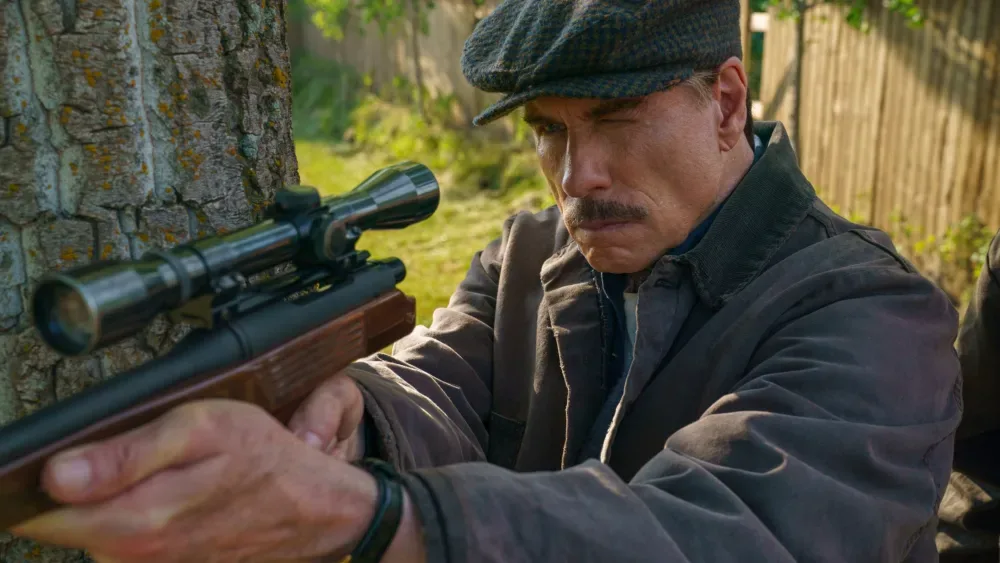
In Roland Joffé’s “November 1963,” which opened the Torino Film Festival with its international premiere, Travolta plays Johnny Roselli, a real-life wiseguy turned showbiz fixer described as an Al Capone protégé whose career took him from Hollywood to Las Vegas to the Bay of Pigs.
“He was an odd mix,” Travolta said. “He was the guy who asked Sinatra to connect Kennedy with the mob. He hooked Kennedy up with Marilyn Monroe. He was a Hollywood icon of sorts, and had this other, darker side as a hitman. That’s complex. I’ve done dark subject matter before, but this was real.”
Roselli was purportedly a CIA go-between and sharpshooter. The film takes that history further, imagining him as a key triggerman on the Grassy Knoll.
Travolta recalled hearing the news as a second grader in Englewood, New Jersey. “The announcement came at 11 a.m. Eastern Standard Time that the President had been shot, and then three hours later, at 2 p.m., they confirmed that he had passed,” he said. “All I can remember is being home with my father, glued to the television, sitting on his lap and trying to make sense of it all.”
On set, he said, he was asked “to play a very evil man with moments of humanity.” “The actors were all suffering because everybody who was hired was a very decent person, and we all had to play, to some degree, people who were not,” he said. “So it was harder to go home every night. It took a glass of wine and a nice dinner to snap out of the zone.”
Watching the finished film at Torino’s opening night, he said, he had an out-of-body experience. “I’ve never seen myself lose my soul in a film, and [here] I was soulless,” he said. “When I looked at it on screen, I went, ‘Oh my god, he’s the devil.'”
Written and produced by family members of Windy City crime boss Sam Giancana, “November 1963” foregrounds the Chicago Outfit’s role in the assassination plot, leaving CIA and government involvement for a possible follow-up. “This is not history; it’s about human beings,” Travolta said.
Joffé said the deliberately incomplete picture appealed to him. “I’d say this story is probably 90% true, insofar as no one will ever know what really happened,” he said. “What’s most important to me is whether it’s credible.”
The film casts slain Dallas policeman J.D. Tippit, whose murder was attributed to Lee Harvey Oswald, as a key conspirator. “I reject the conspiracy theory,” Joffé said. “If it were a conspiracy, we would have known by now, and we absolutely do not. What it was is collusion, and collusion is very different. Collusion is subtle. It happens in the shadows. It’s a nod, a wink, a knowing glance. It’s putting a gun in the right place.”
“It’s not about control,” he said. “It’s about the fact that life is chaotic, and the killing of the President comes out of that. We made a film about chaos.”