Baz Luhrmann’s Romeo + Juliet turned 90s teens on to Shakespeare
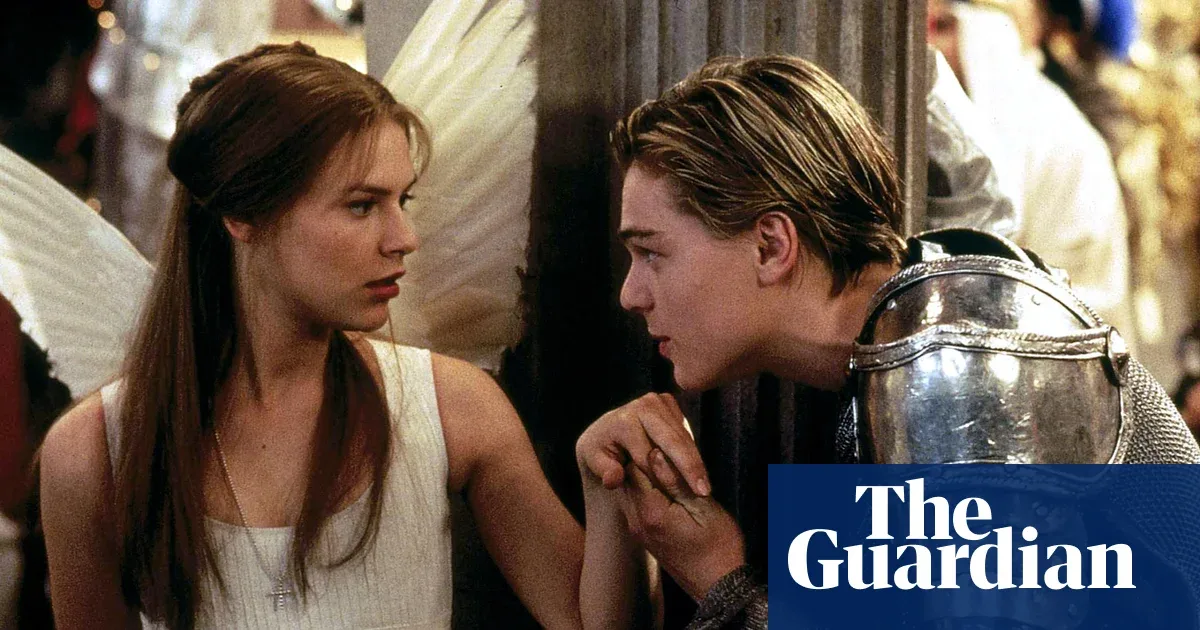
Romeo + Juliet is not the most renowned or beloved of Shakespeare’s plays, but it is perhaps the most foundational. The 16th-century tragedy of love-addled teenagers and white-hot resentment is often an English student’s first introduction to the bard, more accessible to teens than the austere machinations of Macbeth, Hamlet or Othello. And if Romeo + Juliet is the young person’s entry to Elizabethan English, no version is more worthy of the term “gateway drug” than Baz Luhrmann’s 1996 film, which reimagined Verona’s family feud as a tropical gang war and launched teenage crushes with the faces of Leonardo DiCaprio and Claire Danes.
The maximalist interpretation, released 30 years ago this week, keeps the Elizabethan verse but announces its divergence from rigid classicism from the jump. The scene is set in fair Verona beach by a news anchor on a TV set, relaying the woe of two star-cross’d lovers before clips of civil strife. Fresh off his breakout success in 1992’s Strictly Ballroom, the Australian director mapped the medieval story on to 90s tabloid fixations: grainy footage of violence in the streets, magazine headlines of capos and criminals, helicopter views of car chases and riots that recalled the media circus around the OJ Simpson chase two years prior. Luhrmann’s vision of two warring families as rival gangs, with their own economic operations and marked territory, tapped into the era’s preoccupation with gangland as a source of transportive art and as a conservative fixation on intrinsic criminality.
Luhrmann and his wife, costume designer Catherine Martin, reimagined Verona as a sun-scorched beach city, using real locations including Mexico City’s Immaculate Heart of Mary Church and Chapultepec Palace and Veracruz’s Boca del Río. The Montagues, in open Hawaiian shirts, and the Capulets, urban cowboys in Cuban-heeled boots, brandish guns marked by Catholic iconography. Luhrmann cut and spliced and twirled the camera in a frenetic display of manic energy.
The film’s raucous shootouts and parties now read as an obvious precursor to Euphoria high school. Critics dismissed it as vulgar and garish, but audiences turned out en masse: Romeo + Juliet made over $147m against a $14.5m budget, boosted in part by a period-defining soundtrack with needle drops from The Cardigans, Everclear, Radiohead and Garbage.
The film’s two luminous stars brim with the type of uncut, untameable desire known only to youth. It was a movie about teenage obsession that sparked a million teenage obsessions with DiCaprio. But it is a 17-year-old Danes, in a role originally intended for a text-accurate 13-year-old Natalie Portman (correctly deemed too childlike next to a 21-year-old DiCaprio), who shines on a rewatch. When her face falls on realizing her lover’s suicide, you feel the ear-ringing fall of one’s first galling disappointment.
That is the genius of Luhrmann’s Romeo + Juliet: it is a feelings-first movie, a portrait of teenage melodrama where all emotions exist only at full volume. That is true for the highs, as when Harold Perrineau’s Mercutio enters with a high-kick in full silver drag to Kym Mazelle’s Young Hearts Run Free, and for the lows. Mercutio’s death at the hands of John Leguizamo’s Tybalt lands as equally tragic as the lovers’. And Romeo’s agonized poisoning, which frankly puts DiCaprio’s more famous death in the North Atlantic to shame, lands as a timeless gut-punch.
Luhrmann’s film more than transcended the more straightforward Shakespeare adaptations of the era, such as Kenneth Branagh’s Much Ado About Nothing and Hamlet, Trevor Nunn’s Twelfth Night and Michael Hoffman’s A Midsummer Night’s Dream. It arguably inspired the modernizations kicked off by 1999’s 10 Things I Hate About You and continued by Easy A and She’s the Man, and evidently inspired a recent Broadway revival starring Rachel Zegler and Kit Connor. Thirty years on, we are still waiting for the next truly great, pop culture-shifting Shakespeare moment.