How ‘Backrooms’ built its yellow-wallpaper world on four stages
Before Kane Parsons’ “Backrooms” became a $400 million global box office success, it was a YouTube series with 22 episodes, each running from two minutes to 45 minutes and exploring the “Backrooms” lore. The series was a viral hit, and so was the movie.
But production designer Danny Vermette and visual effects supervisor Ed Douglas were not initially aware of the series. After a call from producer Chris Ferguson, both went down the rabbit hole. Speaking with Variety, Douglas, whose work is shortlisted for Oscar consideration, recalled his first response: “Is this real? Is this CG? What is this going to be?”
After a call with Parsons, he learned how the world had been built using Blender, 3D creation software used for modeling, animation, CGI, rendering, visual effects and simulation. Douglas said: “We started talking about what our process would be. Would this be a very traditional, film VFX process or would we bring in a hybrid process with the Kane Parsons Blender workflow? It was that combined process that we built.”
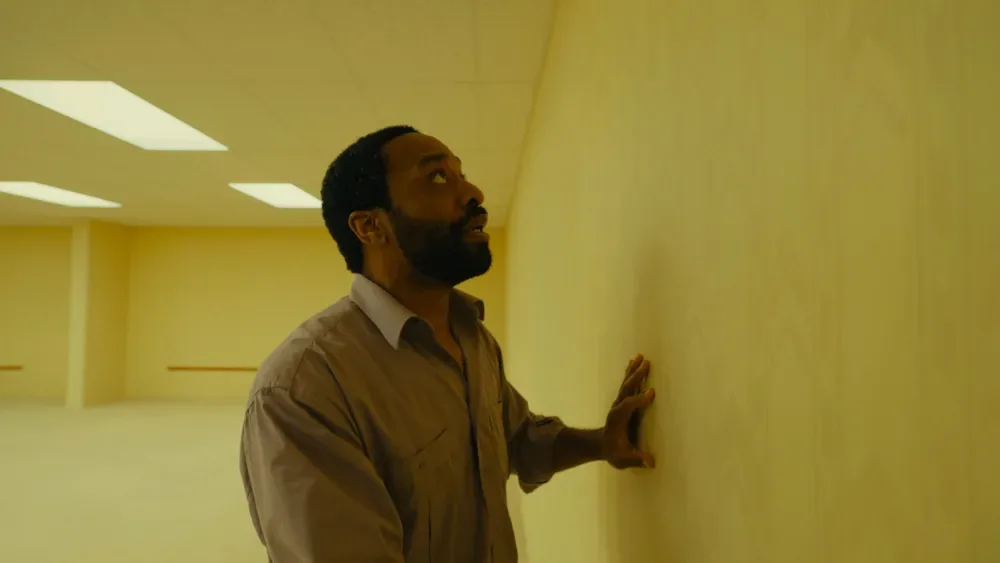
Set in 1991, the film stars Chiwetel Ejiofor as Clark, a furniture emporium owner who discovers a portal in the basement of his store. Clark becomes obsessed with the alternate world, a never-ending series of liminal spaces lined with carpet and yellow wallpaper.
Vermette spoke with friends familiar with “Backrooms” and Parsons. “I fast realized how versed Kane was in this universe, and how truly immersed he had been for several years and realized I needed to catch up with some of this lore and the theory behind how it works if we were to figure out a way to make this work and build this universe together.”
The team decided the set would be a practical build so the actors could be fully immersed, with a handoff to VFX to combine practical builds and visual effects. Vermette explained: “I had the constraints of budget and square footage. So it was about putting a square peg in a square hole. I knew exactly what our limitations were. The more we’re grounded in the reality, the more the visual effects will work, will sell. Let’s take the practical world as far as we can, and then extend and enhance.”
He added: “If the actors are in the space interacting with it, let’s build it for real. And then building all those sets for real gave us a model so we could make sure we’re mimicking exactly how the wallpaper works, how the ceilings work, how the light works. And then when we get into the clipping, people passing through the walls.”
Clark’s furniture store basement sat right next to the first backroom space. The actors could walk from one to the other, and the camera could pass through one into the other. Douglas said: “We put blue screens up on either side as we were filming these, and then in VFX post-production, we would add the walls back in.”
In the final movie, what sells it is a shadow intersecting in a very unreal way. Douglas said: “The visual language of this wasn’t like a fantasy movie. There’s no sparkles, distortion or ripples. It was two computerized objects sliding straight through each other, so there’s nowhere to hide. It was very challenging, very meticulous work.”
Much of the effort went into creating vertical liminal spacing. For the Vertigo Room, which Mary (Renate Reinsve) discovers while fleeing from Pirate Clark, Parsons said it was a straightforward build. They found a building in Downtown Vancouver owned by a bank. “We hollowed out a skyscraper.” Blue screen helped. “We built everything the actor is interacting with physically. As Mary walks along the pathway, the hallway that she’s going through before is a separate set, with a separate door and then we’re jumping over into an L shape. We’ve got a ceiling that goes far out enough that the staircase with the little trap door those are real tiles that she’s going up into — and there is enough of a return when she goes through the door and climbs out, so she can safely hoist herself up a bit.”
In the end, “Backrooms” came together with a set that measured over 30,000 square feet and used four stages.