TMC’s seabed nodules need a refinery that isn’t built yet
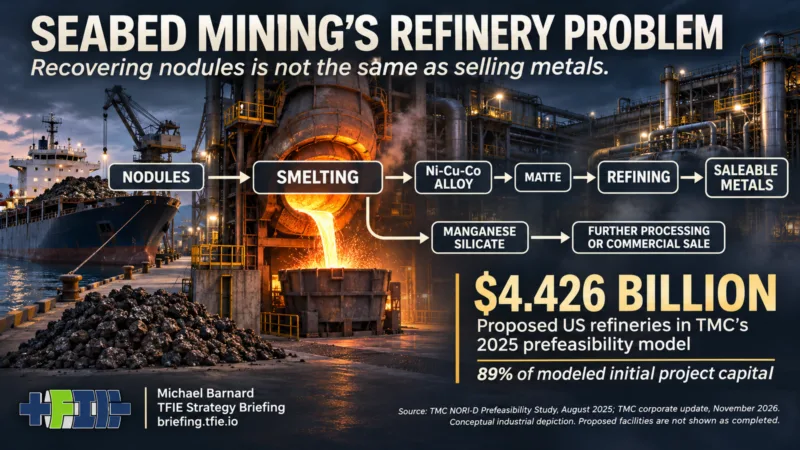
The Metals Company plans to recover polymetallic nodules from the seabed and sell the nickel, copper, cobalt and manganese they contain. According to CleanTechnica, that business needs an industrial processing system before its revenue projections become sales.
CleanTechnica reports that TMC’s November 2026 update exposed the timing problem. Its proposed refinery complex in Brownsville, Texas, may not be operating when offshore collection begins. An established Japanese smelter operated by Pacific Metals, or PAMCO, is the prospective initial route, but it needs modifications to accept commercial volumes of nodules.
TMC’s 2025 prefeasibility study allocated $4.426 billion to two proposed US hydrometallurgical refineries, about 89% of the study’s $4.971 billion of initial project capital. The newer Brownsville proposal has a different industrial scope. The 2025 figure shows the size of the processing business TMC’s economics must support, not a completed financing commitment for Brownsville, according to the report.
A nodule delivered to port is a complex mineral feedstock, not a sale of four finished metals. One processing route smelts nodules into a nickel-copper-cobalt alloy and manganese silicate, converts the alloy into matte and refines the matte into marketable metals or chemicals. The manganese product needs customers or additional treatment. Each step consumes capital, energy, reagents, skilled labor and working capital.
TMC has a meaningful metallurgical program. Its third-quarter 2026 SEC filing describes earlier North American tests of about 70 tons of nodules and a 2,000-ton industrial demonstration at PAMCO’s Hachinohe facility. Further work at SGS in Canada tested the refining of intermediate material into battery-grade products. PAMCO has completed feasibility work on treating roughly 1.3 million wet tons per year through a modified existing facility.
The November 12 corporate update nevertheless put the industrial dependency in plain view. TMC’s preferred Brownsville facility will be difficult to complete before the first commercial nodules arrive, and the Japanese facility requires modifications and aligned schedules, CleanTechnica reported. Korea Zinc, Glencore, Hatch, Mariana Minerals and other partners provide expertise and commercial relationships, but the construction, commissioning, financing and refining arrangements remain to be completed.
In a 2025 seabed mining techno-economic assessment, metallurgist Lyle Trytten and the report’s author calculated a $553-per-ton contained-component reference value for representative Clarion-Clipperton Zone nodules at fixed historical metal prices. Using estimated purchase terms informed by analogous mineral markets, the same assessment gave a modeled raw-feed value of $188–256 per ton, or about 34–46% of that contained reference value. The values are estimates on a common reference basis, not bids from refineries or the profit a processor would pocket.
The mining company has three main choices, according to the report. It can sell the raw nodules at a price a processor can afford. It can keep title to the material and pay a plant to process it, provided the contract sets capacity, treatment charges, recoveries and risk allocation. Or it can finance and operate refining facilities and pursue a larger portion of the finished-metal revenue.
TMC’s 2025 study projected $13.622 billion of lifetime processing costs and $3.254 billion of refining costs, together about $103 per wet ton, or 42% of its modeled operating expenditure.
Impossible Metals has a different, less developed processing position. Its published strategy begins with outsourcing to modified plants in allied countries and envisions dedicated facilities later. Its economic model used approximately $791 per ton of contained-metal value under its selected prices and grades, deducted a $230 processing charge, and arrived at roughly $560 per ton delivered to port. Those numbers use different input assumptions and cannot be treated as a direct comparison with the $188–256 estimate.
Ravensthorpe, Goro and Ambatovy had familiar metallurgical technologies yet encountered expensive commissioning and operational difficulties, the report noted. An unusual feedstock, high-volume throughput, uncertain manganese outlets and synchronized offshore and onshore ramp-up add challenges for nodule ventures. TMC has considerably more testing and more developed partners than Impossible Metals, but neither has demonstrated a fully operating processing chain at its intended scale, recovery, capital cost and commercial terms.
Government financing could change who carries part of the risk, but not what must be built or operated, according to CleanTechnica. Investors, taxpayers and prospective processing partners need to know who provides the billions in capital, who carries the ramp-up risk and how much of the metal value the collector retains after every participant has been paid.