The Hegseth Vote Failure Is Really a Test of Jeffries
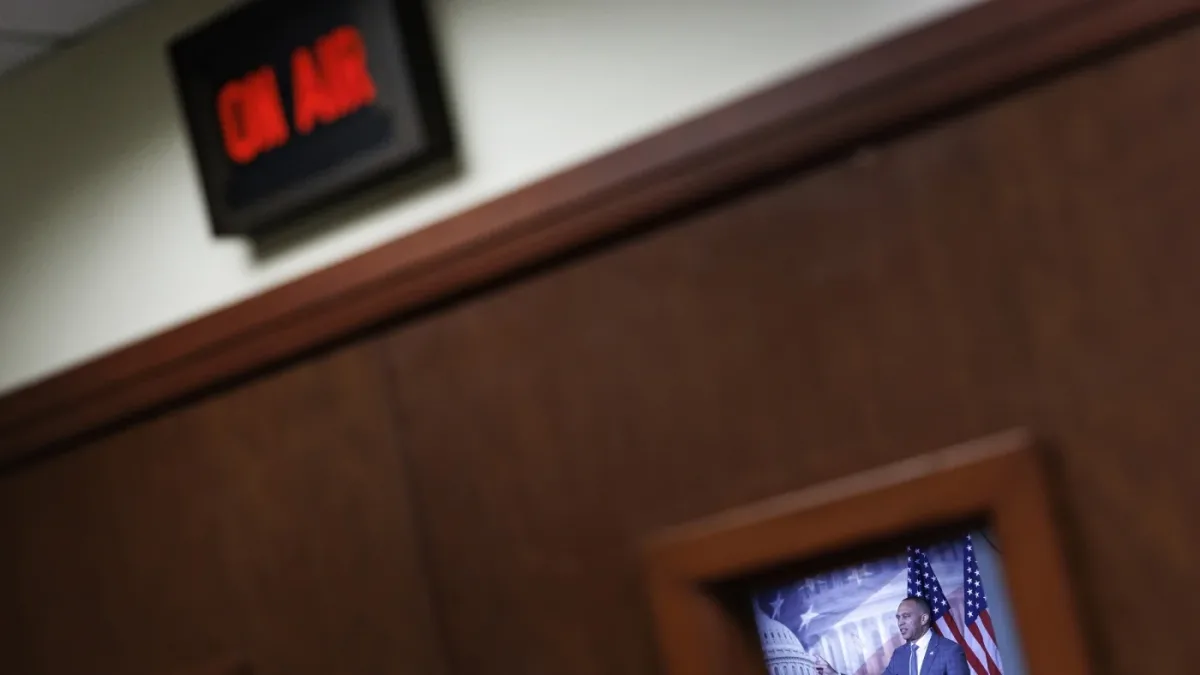
The House failed to advance an impeachment effort against Defense Secretary Pete Hegseth, with 11 Democrats absent from the vote. NPR frames the result as the first post-election test of Democrats’ ability to get things done, and calls it a failure.
Only NPR’s item addresses the Hegseth vote, so there is no outlet disagreement to weigh here. What makes the piece worth reading is the arithmetic it lays out. If those 11 Democrats had been present and no additional Republicans had shown up, the attempt would have gone forward. Only one Republican, Rep. Thomas Massie of Kentucky, who led the effort, was in favor. NPR notes the GOP still controls the floor, so a Democratic speaker would have been able to leave the vote open longer for the absent members to cast theirs — a point that shifts the story from Republican opposition to Democratic vote management.
Then the Pelosi comparison
The outlet then draws an explicit comparison to Nancy Pelosi, describing the former speaker as known for the discipline she kept in her caucus — she knew where the votes were, who was voting how and why, and, most importantly, did not move forward with efforts that did not have the votes. NPR writes that Hakeem Jeffries, the heir apparent Democratic leader, is going to have the largest majority in Congress since the early 1990s, and that his leadership and agenda priorities are going to be scrutinised and compared to Pelosi. That is NPR’s characterisation, and it is doing a lot of work in the piece: it sets the standard against which Jeffries will be measured.
There is an irony in the item that it does not lean on but does not hide either: Pelosi was herself among the 11 absent, having flown back to San Francisco for a veterans’ event.
The piece disagrees with itself
NPR also raises a second question that cuts against the first: whether this kind of effort is what people want in the first place. It notes the election saw GOP wipeouts due in no small measure, in NPR’s phrasing, to the Iran war — and asks why, after that, only one Republican supported the impeachment push.
Both criticisms cannot comfortably be true at once, and NPR leaves that tension standing. Faulting Jeffries for losing a vote while questioning whether the vote should have been held is not a contradiction the outlet resolves; it simply puts both questions to the reader.
Elsewhere in the day’s reporting, NBC reported that Melania Trump hosted Russian envoy Kirill Dmitriev and Ukrainian parliamentarian David Arakhamia at the White House, expressing hope that a six-day humanitarian ceasefire around Oleshky would inspire a peace more enduring than a temporary ceasefire. NBC noted Russia has repeatedly rejected wider ceasefire calls since its full-scale invasion nearly five years ago. NBC also reported that Russell Brand was found guilty of rape and sexual assault, with the Metropolitan Police’s Det. Supt. Andy Furphy saying Brand used his influence, status and fame to exploit and sexually offend. Separately, Fortune reported that 72% of Americans say they don’t plan to use AI for holiday shopping, up from 49% in 2025, per a Bank of America survey.
Why it matters
Democrats are measuring their new leader against Pelosi’s discipline before they have the majority that would let him exercise it. The 11 absences are a small number with an outsized signal — a preview of how the party’s internal management will be judged the moment it gains real power. NPR’s own framing of the vote as a failure is the first data point in that ledger, and the outlet’s decision to pair it with a question about whether the vote should have happened at all suggests the standard being applied is not yet settled.