Rubio Tells Conservatives Defeat Isn’t the End
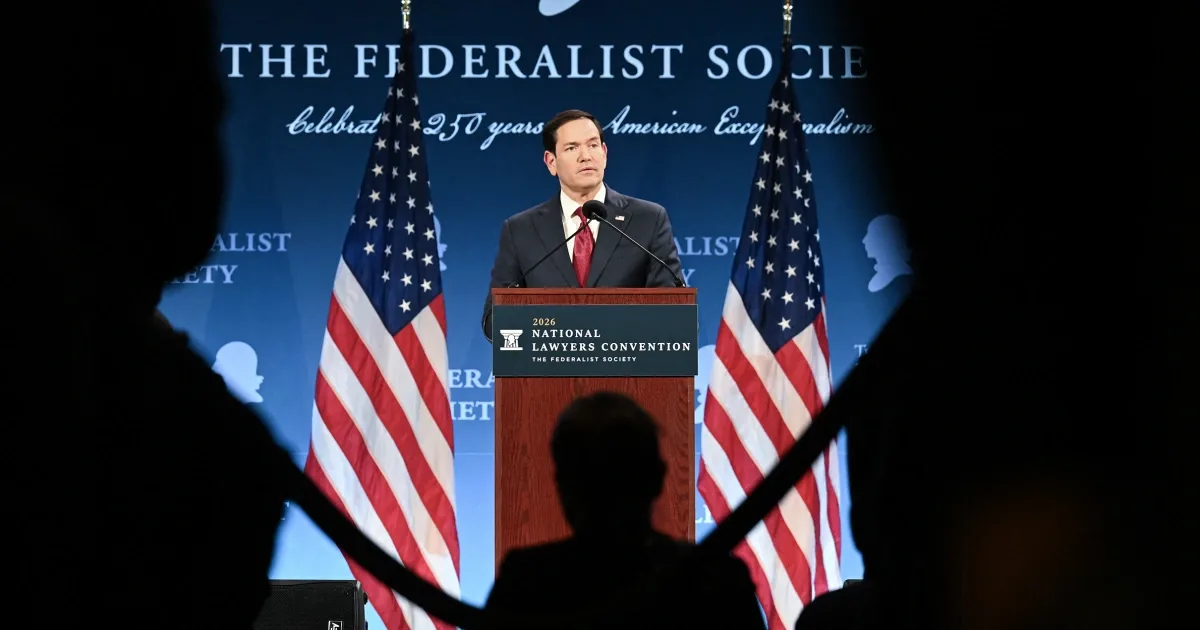
Secretary of State Marco Rubio used his first major remarks since Election Day to downplay Republican midterm losses, telling the Federalist Society on Friday that “politics requires more than simply winning elections.” The speech is notable less for what it concedes than for where it locates power — not in the offices Democrats just won, but in institutions conservatives already contest.
NBC News reported that Rubio, whose name has been floated as a potential 2028 presidential candidate, told the National Lawyer’s Convention in Washington that “those who believe that one setback, one defeat, one bad election spells the end of the republic should look to you as an example for inspiration.” He added that “great things that last are built in decades, not election cycles,” and that “there will be more victories, and there will be more defeats.”
The core of the argument was institutional. NBC News reported Rubio urged the crowd to remember that government “is not the only source of political power,” pointing to universities, the press and “the whole expanse of civil society.” He said elections “decide who holds office for a season, but elections, they do not decide by themselves what our institutions teach or what our lawyers believe.”
Rubio also used the speech to push back on international criticism, condemning what NBC News described as his condemnation of the “endless barrage of claims about America’s alleged violations of international rules and norms” — including allegations over strikes on boats allegedly used to traffic drugs in the Caribbean and over the administration’s immigration enforcement. He defended the U.S. capture of former Venezuelan President Nicolás Maduro and the continued war in Iran, saying “none of this has anything to do with any real higher standard of justice. It is a function of the people who control the official organs of global governance.” He added that for “this global elite, international law is not a neutral body of rules. International law is an instrument, an instrument to advance their interests.”
Other outlets covering the aftermath of the midterms have emphasised different things. CleanTechnica, writing about COP31, reported that the Democratic sweep “delivered a resounding victory for the Democrats, and a major loss for US president Donald Trump and the Republican party,” and that the party had gained control of the Senate and the House. Fortune, in a piece on the solar supplier Nextpower, wrote that the clean-energy sector “bottomed out during the first two years of the new Trump administration and should begin to rebound after the blue wave of Democrats taking over in January following the midterm elections.” NBC News, covering the markets, reported that investors were weighing “the prospect of an AI investment slowdown resulting from Democratic midterm victories.”
The contrast is stark without being contradictory: one account has Democrats arriving with a mandate, another has a sector pricing in a policy turn, a third has investors selling on it. Rubio’s speech does not dispute any of that. It argues that the meaning of an election is contested terrain, and that the fight continues in universities, courtrooms and civil society regardless of who holds office.
What makes the remarks worth noting is the audience and the framing. A senior cabinet official, floated as a future presidential contender, chose a lawyers’ convention to argue that legal and international institutions are instruments of an opposing elite — and to treat an electoral defeat as a setback rather than a verdict. This suggests the administration’s post-election posture is not retrenchment but a redirection of the fight to institutions it does not control. Whether that reassures a party that just lost, or signals that it intends to keep contesting the ground it lost, is the question the speech leaves open.